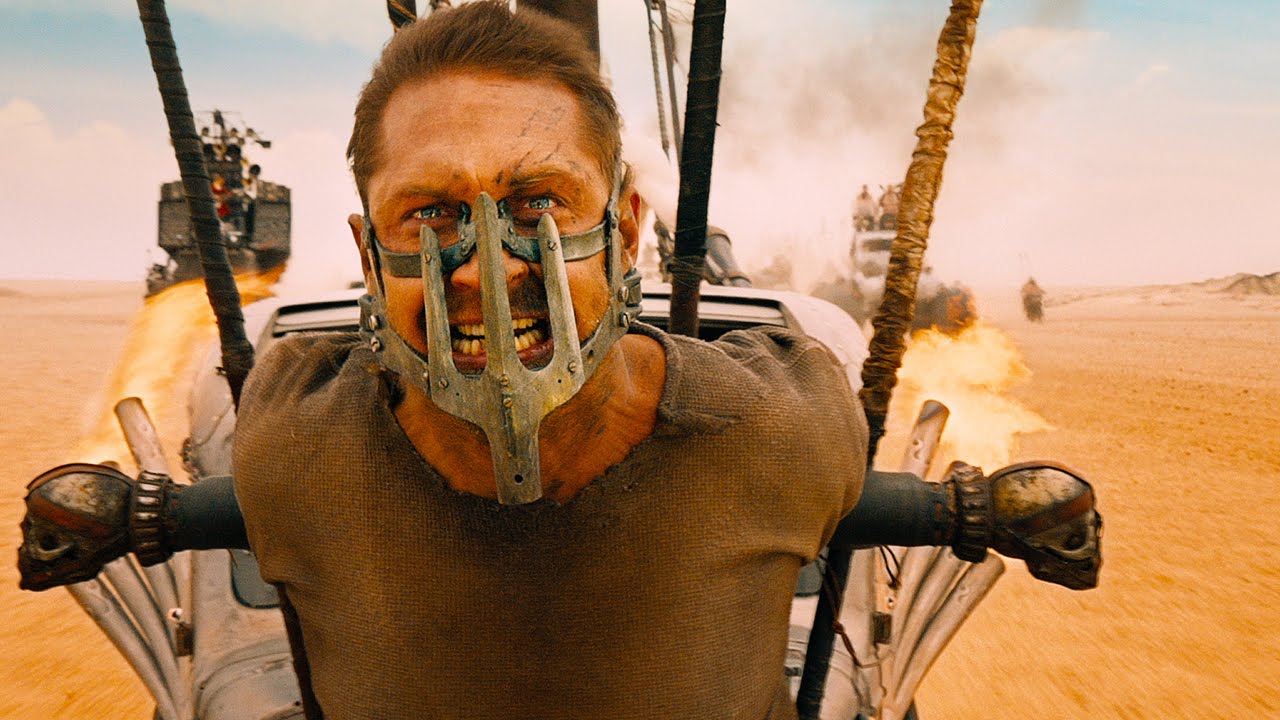
The Iraq war meant that filming had to be delayed in Namibia.
The film was supposed to be an animated 3D film, but developed into a 3D live action movie.
Filming was delayed twice.
The filming first concluded in 2001.
In 2013, they had to go back and film additional scenes.
In 2003, Warner Bros panicked and insisted that someone write a script for the film.
In 2010, stars signed up to be in the film.
The film was originally going to be filmed at Broken Hill, but moved to Namibia after consistent heavy rainfall occurred.
$7.5 million was spent on 957 national airings across 42 networks led by MTV and Comedy Central.
Crew spent 10 months in Namibia to film.
Over 80% of the effects seen in the film are real practical effects, stunts, make-up and sets.
CGI was used sparingly mainly to enhance the Namibian landscape, remove stunt rigging and for Charlize Theron's left hand which in the film is a prosthetic arm.
The flame-shooting guitarist in the film is Australian artist/musician Sean Hape, better known as Iota.
The guitar that Iota used in the film weighed 132 pounds, and shot real gas-powered flames, which was controlled using the whammy bar.
The film editor, Margaret Sixel, is director George Miller's wife.
The jacket worn by Tom Hardy is a replica of the one that was worn by Mel Gibson in the second two movies of the original Mad Max trilogy.
The film's storyboard was made even before the screenplay.
This is the second Mad Max film to have featured Hugh Keays-Byrne. He played the villain Toecutter in Mad Max (1979).
Charlize Theron reportedly shaved her head for the role of Furiosa and as a result had to wear a wig for her role in A Million Ways To Die In The West (2014.)
Tom Hardy suffered a broken nose during filming when Charlize Theron accidentally elbowed him.
Tom Hardy had lunch with Mel Gibson to discuss him taking over the iconic role of Max Rockatansky. Gibson told Hardy that he was fine with the role and gave him his blessing.
Margaret Sixel had 480 hours of footage to edit; watching it took three months.
Mel Gibson was originally intended to star again as Max back in 2003, but because George Miller ran into problems with shooting locations, and Gibson's interest in The Passion Of The Christ (2004), it never happened.
The music box that was given to the Feral Kid in Mad Max 2: The Road Warrior, was resembled by the music box that was given to one of the wives in Fury Road.
John Seale came out of retirement to head the film's cinematography.
A comic book series showing how Immortan Joe came to power is being published by Vertigo.
The gesture made by the war boys when they mesh their fingers together is the sign of the V8; they literally revere and worship the power of the engine. It may also be viewed as a reference to Valhalla.
Many characters' names are never said in full or at all onscreen and are only provided in the credits at the end of the film.
Max and the main antagonist, Immortan Joe, never directly interact with each other, apart from when Max hijacks the People Eater's Limousine. They exchange gunshots during the takeover.
George Miller told cinematographer John Seale to keep the main actor centered in the screen so that the viewer's eye did not have to search the screen due to the film's fast editing style.
There is a fan theory that Mad Max in this film is actually the Feral Kid from the second film, Mad Max 2: The Road Warrior (1981). However, a Vertigo comic miniseries cowritten by George Miller establishes that Hardy's Max is the same character as Gibson's Max.
The film used three identical War Rigs, the large main truck in the film. They were based on a Czechoslovakian all-wheel drive military vehicle.
The script contains almost no profanities.
In the German-dubbed version seen in Germany, as in the original English version, the Buzzards speak Russian. In the Russian-dubbed version seen in Russia, they speak German. This way, they sound foreign and evil to everyone.
When Max is tied to the front of Nux's car, there is a skull with a pilot's cap and goggles on a spike above him. This is a reference to the Gyro Captain, who appeared in Mad Max 2: The Road Warrior.
Riley Keough, the actress who plays the red-haired bride, Capable, is daughter of Lisa Marie Presley and grand-daughter of Elvis Presley.
Writer and feminist Eve Ensler (The Vagina Monologues) was consulted to enhance the portrayal of female characters.
The "crows" on stilts are the boys abandoned by the Vuvalini when the green place turned sour.
George Miller directed the entire Mad Max action franchise, noted for its violence. Ironically, he is also director of three family friendly movies: the second of the Babe movies, and both Happy Feet movies.
Night scenes were filmed in bright daylight, deliberately overexposed, and colour-manipulated. In many shots, the sky was digitally replaced with more detailed or interesting skies.
Rosie Huntington-Whiteley remarked that the cast and crew fraternized a lot after work during the shoot since they were all residing in a small Namibia town (the nearest to the desert) without any tourist attractions or fine dining.
Near the end of the credits, there is a memorial dedication that reads "Lance Allen Moore II, May 24, 1987 - March 10, 2015". Moore was a Mad Max fan killed in a motorcycle accident near Silverton, New South Wales, Australia, where Mad Max 2: The Road Warrior was filmed.
Several vehicles in the film, including the War Rig, were left-hand drive.
Charlize Theron and Tom Hardy reportedly did not get along during filming, with Hardy's method acting reportedly bothering Theron.
At the final vehicle battle, one of the Immortan Joe's henchmen scares Furiosa, before attacking her, with the exact same hiss as the Toecutter in Mad Max 1.
This is George Miller's first R-rated movie since The Witches of Eastwick (1987).
This is the first Mad Max film to have been made since Beyond Thunderdome, a gap of thirty years in between the two films.
The paracord bracelet that Max wears belongs to Tom Hardy himself.
Nicholas Hoult learnt how to knit from a makeup artist during the seven-month shoot in Namibia.
With a runtime of two hours, this is the longest film in the Mad Max series.
The character Toast the Knowing is named after visual effects crew member Shyam V. Yadav, who is known for serving free French toast to thousands of people all over the world.
Toast the Knowing was played by Zoe Kravitz, the daughter of famous musician Lennie Kravitz.
Actors were digitally duplicated in post production to expand the crowd scenes so in reality only a few actors were actually needed on set during filming.
During the flashback sequence after going through the crows, you can see eyes popping out briefly. This is an homage to Mad Max, when a rider crashes into the front of a semi.
An R-rated version and a PG-13 version were both made of the film. Warner Bros had decided to make the film R-rated after test screenings.
Tom Hardy had a dog named Max that was given to him when he was a teenager, he passed away in 2011. The dog's name was an honor to Mad Max.
Second unit director and supervising stunt coordinator Guy Norris was in charge of over 150 stunt performers, which included Cirque du Soleil performers and Olympic athletes.
Megan Gale, who plays The Valkyrie, was previously cast as Wonder Woman in George Miller's film Justice League: Mortal before it was cancelled. This is her first Hollywood film.
When Max awakes abruptly from his dream right after the blue sequence, the last image of his dream is a close view of eyes popping out of a face. This footage is from Mad Max 1, when Toecutter is killed.
Certain screenings have shown the film in black and white. The crossed belts that the Valkyrie, played by Megan Gale, wears are the same belts Max wore in Mad Max: Beyond Thunderdome. The brass belt buckle has been covered or replaced.
The girl who Max sees in his visions, commonly believed to be his daughter, is in fact Glory the Child, who can be seen in the comic series.
George Miller described the film as "a very simple allegory, almost a western on wheels."
Teresa Palmer was originally cast but due to delays of the production, she dropped out and was replaced by Abbey Lee.
Australian crows or ravens are used in the Mad Max films, including Fury Road, as symbols of death and destruction.
Despite having custom logos starting the film, Warner Bros. Pictures and Village Roadshow Pictures (and RatPac-Dune Entertainment) aren't credited until the very end of the movie, after all other credits have rolled.
Amid claims of the film going over-budget and behind schedule, Warner Bros. then sent a produce to oversee production in Namibia.
George Miller is the first creator of a film franchise to reboot his own franchise.
Although Max never gives his exact nickname to the audience, he refers to himself with similar words like "insane" or "crazy".
The film contains about 2,700 cuts of its entire running length, which is equivalent to 22.5 cuts per minute compared to Mad Max 2: The Road Warrior's 1,200 cuts of its 90 minute running time equivalent to 13.33 cuts per minute.
Filming lasted 120 days, and the film runs at 113 minutes without credits. So, it could be said that each day equals about a minute of the film.
Since Immortan Joe wears a full breathing mask in all of his scenes, no part of his face below his eyes is ever seen.
The cast and crew had to endure extreme heat while filming in Namibia.
This is the first Mad Max film to be released in 3D.
Out of Control of Man With a Mission Feat. Zebrahead is used in the Japanese version of the ending song.
Weta Digital was originally involved with the film when it was scheduled for a 2012 release.
Fans of the popular British tabletop game Warhammer 40,000 noted that Immortan Joe and his army bore a number of uncanny similarities to Ork war band in the game.
Max's sawed-off shotgun misfires when he tries to shoot off Nux's wrist, as it did in Mad Max 2: The Road Warrior.
The movie was originally planned as a sequel to Mad Max and a prequel to Mad Max 2: The Road Warrior. It is believed that Immortan Joe would've been the Toe Cutter, who survived the accident in Mad Max but was badly injured, resulting in his body being battered and broken.
When engine #1 of the War Rig breaks down during the final chase to The Citadel, the sound it makes is the same sound the Millennium Falcon makes when it breaks down in Star Wars: Episode V - The Empire Strikes Back.
This is the only film in the Mad Max series where the last road battle doesn't end in a head-on collision between two vehicles and a main antagonist is killed in the process.
With the exception of Max and Nux, all of the film's male characters are villains. Conversely, all of the female characters are good.
After the War Rig is driven off the platform and the platform begins to rise as it is drawn back up into The Citadel, a lone woman can be seen standing in the center. In the previous wide-angle shot of the crowd, The Wretched were shown begging for a place in Immortan Joe's coterie. This woman, played by Debra Ades, was likely brought aboard to be used as a milker or breeder.
In the last scene of the movie, Furiosa's eye is swollen shut as a result of injury, the same as Max's is at the end of Mad Max 2: The Road Warrior.
In a likely reference, Nux crashes the War Rig in the same way the tanker crashes at the end of Mad Max 2: The Road Warrior.
Body count: 114.
When Max asks Nux if he's a "blackthumb" and can fix enging #1 while they are on the War Rig may be a reference to the character Blackfinger from Mad Max Beyond Thunderdome, who is the chief mechanic in Bartertown.
A deleted scene shows Miss Giddy's fate; she is left with Angharad's body, and attacked by crows (the crows were never added).
In one of the scenes the War Rig has a collision with a black Mack tractor unit. The same style of Mack tractor unit was featured in Mad Max 2: The Road Warrior to pull the fuel tanker trailer.
The blood-bag information tattoo on Max's back contains a description of his capture: "Lone Road Warrior Rundown on The Powder Lakes V8". Calling him a "Road Warrior" is a reference to the second film, Mad Max 2: The Road Warrior.
After Max searches Furiosa's cab for weapons and leaves with all her guns, Furiosa reveals a hidden knife sheathed in her gear shift. In Mad Max Beyond Thunderdome, Max is disarmed before entering Bartertown, but hides a knife sheathed in a fly swatter.
Max's first and last lines revolve around him telling somebody what his name is. The first time he tells the audience in a voice over. The second time he tells Furiosa while giving her his blood.
Immortan Joe wears a face mask for medical purposes, which is functionally similar to the mask worn by Tom Hardy when he portrayed Bane in The Dark Knight Rises. In both films, each character is defeated by the hero damaging or destroying the mask.
Charlize Theron will not return as Imperator Furiosa for Mad Max: The Wasteland. The Mad Max films are influenced by the western genre and like the mysterious gunfighter, Max leaves and moves on to an entirely new adventure.
Max's 1973 Ford Falcon XB GT V8 Pursuit Special (aka The Interceptor), seen in the first two films Mad Max and Mad Max 2: The Road Warrior, is seen in this film as well. Its appearance is indentical to its battered state seen in the second film.
The portion of the blood-bag information tattoo being painfully needled into Max's back at The Citadel that was completed before he escapes reads: Day 12045, ht 10 hands, 180 lbs, No Name, No Lumps, No Bumps, Full Life Clear, Two Good Eyes, No Busted Limbs, Piss Ok, Genitals Intact, Multiple Scars, Heals Fast, O-Negative, High-Octane, Universal Donar, Lone Road Warrior Rundown on The Powder Lakes V8, No Guzzoline, No Supplies, Isolate Psychotic, Keep Muzzled.
If George Miller's Justice League movie had gone ahead, we'd have seen Megan Gale as a warrior long before she shows up in Fury Road as The Valkyrie.
In later scenes, Max appears to be wearing a South African M-83 load bearing vest.
Keeping in line with the previous incarnations, Max barely speaks in the film. This excludes his narration at the beginning.
First Mad Max film to not star Mel Gibson as Max. It was originally rumored that he would have a cameo role as a drifter.
Sound is called diegetic when its source is visible or implied in the world of the film.
Non-Diegetic
Sound is said to be non-diegetic when its source is not present or implied in the narrative universe.
Synchronous
Synchronous sound is sound that is matched to certain movements occurring in the scene.
Asynchronous
Asynchronous sounds match the action being performed however is not precisely synchronised with the action.
Sound Effects
Sound effects are a sound other than speech or music made artificially for use in a play, film, or other broadcast production.
Sound Motif
Sound motif. A sound effect or combination of sound effects that are associated with a particular character, setting, situation or idea through the film. The sound motifs condition the audience emotionally for the intervention, arrival, or actions of a particular character.
A dominant or recurring theme/sound.
Sound Bridge
A sound bridge is a sound that occurs within one scene, and then continues through the transition of the scene ending and then turning into another scene.
Dialogue
Dialogue is aconversation between two or more people.
Voiceover
A voiceover is a piece of narration in a film or broadcast, not accompanied by an image of the speaker.
Direct Address
Direct address is where the character breaks the fourth wall, by addressing the audience and the camera directly, by looking and talking right to it.
Sound Perspective
Sound perspective is where a sound's position in space as perceived by the viewer is given by its volume, timbre, and pitch levels. For example: noises that are closer to the characters will be louder within the scene, in comparison to sounds that are further away from the characters.
Discuss the ways in which the extract constructs the representation of gender using the following:
Camera shots, angles, movement and composition
Editing
Sound
Mise en scène
Camera Shots, Angles, Movements and Composition
The extract of Alice & Luther is constructed through multiple camera shots. The scene starts off with an establishing shot, which is interpreted as a close up of Alice, out in the streets, facing the side of the camera. This emphasizes that the female is going to be the main attention within the scene, as she is the first character to appear. Stereotypically, you wouldn't usually see this happen, as the male character 'normally' obtains the main attention within a TV drama.
The scene then transitions into another close up/birds eye view, this time emphasizing Alice's bag, which contains her dog's ashes. This is still keeping the attention on the female character, as the scene now focuses on her possession, rather than skipping onto the male character of the scene who she is talking to. Again, stereotypically, you wouldn't usually see this happen within TV dramas, as there has been no attention on the male character at all in the scene yet, when 'normally' he would have the main attention for a majority of the time that the scene is taking place.
Perhaps the idea of a possession being shown before the male suggests that the female is more important than the male in this scene, and they want to exaggerate that idea, by keeping the male character a mystery for the first 5 seconds. This is questioning the true stereotypical sense of male and female characters and their dominance as different genders, as their roles have been reversed from what we would know to be 'expected' within a TV drama clip (this being the male as the more dominant, with the female being more of a side character).
The scene then transitions into a close up, this time of the male character. The movement of the camera seems pretty still during this transition, whereas with the woman and her bag, the movement seems to be pretty slick and smooth. Perhaps this could hint at both the man and the woman's attitudes/personalities, as the woman comes across as sly through her facial reactions (and this is emphasized by smooth camera movements, that could hint that her methods are smooth as well, as she needs to keep her plans hidden from the male), and the man seems to come across as dull and straight to the point through his facial reactions (and this is emphasized by a straight forward camera transition, as he needs to get on with his task, without messing around wasting time). This part of the clip blends in with the stereotypical traits of a male character within a TV drama unlike the part before, as he is now starting to get a lot of attention within the scene, just like a male character would be expected to get. The next part of the scene then transitions into a mixture of long shot/two shots of the characters and then back to close ups. This is revealing a bit more about their location outside on the streets, by presenting the location from a wide angle, before then transitioning into another close up, this time in a brand new location which would appear to be Alice's house, presented with a high angle shot at first. Their is more emphasis on the dog's ashes in the second location with this high angle shot, again showing that the male is the lesser important character within this scene, as it is still focusing around the female and her possessions. Alice is then emphasized even more as a sly character, with more smooth camera transitions, whilst Luther continues to maintain within shots that just get straight to the focal point. Bare in mind how Alice is the antagonist and Luther is the protagonist, and that these sorts of camera shots/angles would be common for the villain and the hero. Later on within the scene, an over the shoulder shot is used to show the conversation deepening between Alice and Luther within Alice's home. This show's us the perspective of the room that Luther sees, as it is his shoulder we see everything from. However, even though it is from his perspective, we could still see this as the female being the more important character within the scene, as the focus is all on her through what we are seeing within the shot. These shots continue to occur throughout the rest of the scene, mixing and matching to show different aspects of the room, and each character's own individual plans for being there. The close ups tend to focus more on the character's facial expressions, whilst the mid shots/long shots tend to focus more on the surroundings of the room, potentially for any clues that could be given away.
Editing
Within this extract, there is a lot of editing that occurs. A majority of the shots that occur tend to be edited into short takes, to potentially show that there is a bit of mystery about what is going on between the two characters. These short takes tend to happen through the camera focusing just on one character by being emphasized with a close up, and then go straight onto the next character with another emphasized close up. The use of these short takes could suggest, that both characters are very important and powerful, as they both get a lot of camera time, focusing on only themselves within certain shots. However, this could also be showing the representation of males to come across potentially weaker than usual within a TV Drama extract, as the male is struggling to maintain the lead role within this scene, and within the conversation as a whole, making the woman appear stronger. A lot of shot reverse shots are used as well, to show that each character is constantly looking at each other through the scene, potentially in a battle for dominance between each other in the conversation. This again gives both genders a bit of control and power within this extract. Once the scene changes from outside and into Alice's house, the focus begins to zoom in more on Alice herself, as she is being questioned a lot by Luther. The shots start to become slightly longer, emphasizing every single movement of the characters within the house. The editing within this extract overall is very back and forth, a lot of the time focusing around just one character, with the odd exception where both characters are featured for a dominant battle, breaking away from the stereotypical traits of men and women within TV Drama's, as the females within scenes would usually be considered as the "weaker" gender, therefore usually not getting as much attention as the men would do.
Sound
The scene starts off with non-diegetic sound, as the first few seconds of the extract projects some music as Alice's face is revealed to the camera and the audience. The music appears to be very dark and dramatic, and this could perhaps emphasize Alice's character and personality within this extract.
The scene then quickly changes into diegetic sound, as you can hear the two characters making conversation, alongside some background noise from cars and other street noise. When the characters talk about more serious topics, the background noise increases, almost mimicking them.
The scene then quickly changes into Alice's apartment, and at first absolutely nothing can be heard. There is no noise until the two begin to talk again, producing only diegetic noise once again. The scene carries on like this for a good 20 seconds, until Alice's words "black hole" are emphasized with more dramatic dark sounding music. The rest of the scene then projects both non-diegetic and diegetic sound, by focusing in on the two characters talking, with the dark music still playing over the top.
As the scene reaches closer to the end, the music begins to project in sound level, mimicking the idea that their conversation will be left at a cliff hanger for the audience by Alice's words, again making her suspicious ways seem more powerful on camera in comparison to the man, ending the scene by saying "not if I get you first".
Mise En Scene
The clothing within this scene is seen to be very formal with both characters. Alice is seen wearing a purple coat and black trousers, whilst Luther is seen wearing a grey business suit. The fact that both characters are wearing very formal outfits, could suggest that both characters have a lot of power within the scene and within the TV Drama as a whole, as they are both dressed in expensive looking outfits, showing that they both could be very wealthy. This is again breaking the stereotypical traits when it comes to gender, as the female would usually be in something slightly less expensive than the male, as he would be seen as the more dominant/successful character within the TV Drama. Alice is seen to be wearing very natural coloured makeup, on her eyes and lips. Perhaps she has done this to mimic the idea that as she is the villain, she doesn't want everyone searching for her, and so she wears minimal makeup, because it causes less attraction. This could also suggest that the show is more represented for a male audience, as the female character isn't being focused on entirely in a presentation sense, as normally through the male gaze, females would be wearing a lot of makeup for the man's pleasure. The scene seems to be taking place in a very run down location outside, on a bridge by some skyscrapers, over the top of a very busy road. Alice is seen to be carrying a bag with her, but nothing else is seen within this location. The fact that there is only one prop between two characters emphasizes again the idea of everything being very run down, as things would seem very suspicious if they were carrying around a lot of items of high value in a lower class area. The scene progresses into Alice's house, where more props are seen within the shot. The location is now very more upper class in terms of possession, as Alice seems very well off with all of the items visible.The emphasis of a lot of books laid out on the table behind Alice, also suggests that she is a very intelligent character, as she is most likely to have read a lot within her past, making her a stronger character mentally. Also, the fact that Luther blends in very well with the scenery inside Alice's house could suggest that he isn't as important a character again as Alice, as he doesn't stand out as much as Alice does, based on the colours of his clothing. Throughout the entire extract, the lighting appears to be very bright, as we can clearly see it is set in the daytime. The only time the lighting changes to a darker tone, is when the camera emphasizes the fact that there are ashes present. The setting doesn't go completely dark, but perhaps the slight change in light could mimic the idea of Alice being considered a dark character as she is the antagonist, however that's not discovered straight the way, as she is hiding in the light.
How does the mise-en-scene in your still help to construct the identity of the character(s)?
Consider:
Props
Costume
Lighting
Set Design
Location
Chosen Screenshot: TV Drama - The Vampire Diaries
This scene from The Vampire Diaries contains 4 characters from the TV Drama; 3 looking like they're in a tough situation (focus on the 2 men's struggling facial reactions), due to 1 of the characters being lifeless on the floor, with blood all around his neck/shoulder. The woman in this still appears to be holding a shovel in her left hand, and this could potentially hint towards the audience, that she might be planning to dig up the dead man that is currently on the floor in front of her. Their location appears to be in the middle of the woods, which in a stereotypical TV Drama/Movie could be seen as a 'dangerous' location, as a majority of bad incidents within these dramas, like death for example, occur in this type of location. The shovel could also potentially exaggerate the fact that the scene is currently during the day (we can tell this by the sunlight shining down on the characters), and that they need to hide the body in front of them immediately, as they could easily be seen from how bright the surroundings are in comparison to how it would be if this scene were to happen at night time. Also, the fact that the woman has her back towards the camera and is facing the 2 men in the scene, could suggest that she may be a character of lower power to the men, as she doesn't have the high privilege of actually facing the camera like the other characters. Note as well how the 2 men in the scene are stood up tall and straight, with their fists clenched, whereas the woman is stood hunched over with the shovel, looking like the weakest character out of the lot, as she has the tough job that is deciding whether or not to potentially bury the man that is placed in front of her. The man on the left in this still appears to be wearing a blue buttoned up shirt, that is covered in one corner with blood. This may suggest that he is the one that potentially murdered the man on the floor, and this could explain why he is pulling a face which seems full of struggle, as from what we can see in the still, it looks like he is trying to figure out what to do with the person that he has in fact just killed. The fact that he has no props on him in this still, could potentially give away the idea that he is now powerless with his decisions after killing the man, as he is clueless what to do next, because he can't just go back and bring the man back to life. This could link into his personality and the idea that he is wearing a blue shirt, with blue giving away calm connotations. The man on the right in this still appears to be stood extremely tall and proud, showing off his physical strengths by the way his body is positioned (focus on the direction he is facing, as his body faces the dead man, but his face is looking away). The way in which he is shown, shows similarities to how heroic figures look within movies and their trailers/posters e.t.c., and this could potentially suggest that he has the most power out of all the characters within this still. The fact that the man on the right is wearing black, could give off some connotations of death, which is linking into the fact that he is indeed part of a scene where there is a dead man right in front of him, who he could've potentially killed himself, or helped someone else kill.